For industrial manufacturing and laboratory research purposes only.
Product Specifications
| Parameter | Value |
|---|---|
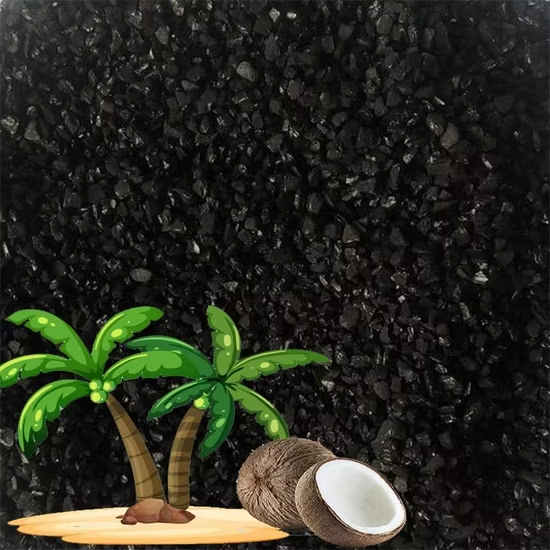
| Model NO. | Coconut Activated Carbon |
| Carbon Content | High-Carbon |
| Pore Diameter | Macroporous |
| Manufacturing Method | Physical-Chemical Method of Activated Carbon |
| Type | Gas Adsorption |
| Appearance | Powder |
| Physical Properties | Pore Volume |
| Chemical Properties | Ash Content |
| Adsorption Properties | Methylene Blue Adsorption Value |
| CAS No. | 64365-11-3 |
| Formula | C |
| EINECS | 264-846-4 |
| Artificial Graphite Type | Activated Charcoal |
| Transport Package | 25kg, 500kg |
| Specification | Powder |
| Trademark | Lvyuan |
| Origin | China |
| HS Code | 3802109000 |
| Production Capacity | 100000tons /Year |
Overcoming Battery Carbon Challenges with High-Carbon Macroporous Powdered Activated Carbon (CAS 64365-11-3)
In battery manufacturing, inconsistent carbon content and pore structure variability often lead to unpredictable electrode performance and production delays. Our team has witnessed firsthand how substandard Powdered Activated Carbon can cause capacity fluctuations and increased production costs for industrial clients across Asia-Pacific.
A Stable and Reliable Battery Carbon Solution
Our Powdered Activated Carbon for Battery addresses these critical issues through its high-carbon content and precisely engineered macroporous structure, ensuring consistent material performance batch after batch. With 10+ years serving chemical traders and manufacturing enterprises in Southeast Asia, we leverage Hong Kong's logistics hub advantages to deliver reliable supply chains even for high-volume requirements.
Typical Industrial Applications
This Battery Grade Powdered Carbon is primarily used in the production of battery electrodes, where its macroporous structure facilitates efficient ion transport and high-carbon content enhances electrical conductivity. It serves as a key raw material in industrial manufacturing processes for energy storage systems, providing essential material stability for large-scale battery production.
Why Key Specifications Matter
The high-carbon content of our activated carbon directly impacts electrode conductivity, reducing internal resistance and improving battery efficiency. Its macroporous structure is critical for ion diffusion kinetics, enabling faster charge-discharge cycles in industrial battery applications. The controlled ash content minimizes impurity interference during electrode manufacturing, while the physical activation method ensures consistent pore volume across production batches—essential for maintaining electrode performance standards in mass production.
What You Gain With Our Product
Using our High-Carbon Battery Carbon reduces production risks associated with material variability, lowering reject rates and improving manufacturing efficiency. Unlike inferior alternatives that compromise battery performance, our product meets strict industrial quality standards, supporting compliance with international battery production regulations. With a stable annual capacity of 100,000 tons, we ensure uninterrupted supply to prevent production line disruptions, ultimately delivering better long-term value through consistent material quality.
Why You Can Trust Us
Every batch of our Powdered Activated Carbon undergoes rigorous quality control testing, including methylene blue adsorption value analysis and ash content determination. We provide comprehensive COA documentation with each shipment, detailing key performance parameters for traceability. Our production facilities operate under strict quality management systems, ensuring consistent product specifications. With dedicated technical support and a 100% satisfaction guarantee on product specifications, we stand behind the reliability of our chemical supply solutions.
Certificate of Analysis & Documentation
Each delivery includes a batch-specific Certificate of Analysis (COA) and Material Safety Data Sheet (MSDS). Detailed检测数据 for specific production batches can be requested using your order number, and complete adsorption performance test reports are available upon request for qualification purposes.
Storage & Handling
- Store in a cool, dry, well-ventilated area, sealed and away from direct sunlight.
- Keep away from incompatible materials, food and feed sources.
- Handle with appropriate personal protective equipment (gloves, goggles, lab coat).
- Follow good industrial hygiene practices. Avoid inhalation and skin contact.
- Refer to MSDS for detailed storage and safety instructions.
How to Place Your Order
Initiate your purchase by submitting an online inquiry with your specific quantity and packaging requirements. Our technical team will confirm product specifications and arrange sample provision for your evaluation. Once specifications are approved, we process bulk orders with flexible delivery options through our Asia-Pacific logistics network, including bonded warehousing services as needed.
Frequently Asked Questions
Q: What is the recommended shelf life for this product?
A: When stored properly in sealed containers under recommended conditions, the product maintains its specifications for 24 months from the production date.
Q: Is this product suitable for direct use in food or pharmaceutical applications?
A: No, this product is strictly for industrial and laboratory research use only, not for direct human consumption or medical applications.
What documentation is provided with each shipment?
A: Each order includes a Certificate of Analysis (COA) for the specific batch and a Material Safety Data Sheet (MSDS) with handling instructions.
Q: Can you accommodate custom packaging or specification requirements?
A: We offer custom packaging options for bulk orders and can adjust certain production parameters to meet specific industrial requirements—contact our technical team for details.
Q: How is the carbon content verified in your product?
A: Carbon content is determined through elemental analysis following standard industrial testing protocols, with results documented in the batch COA.